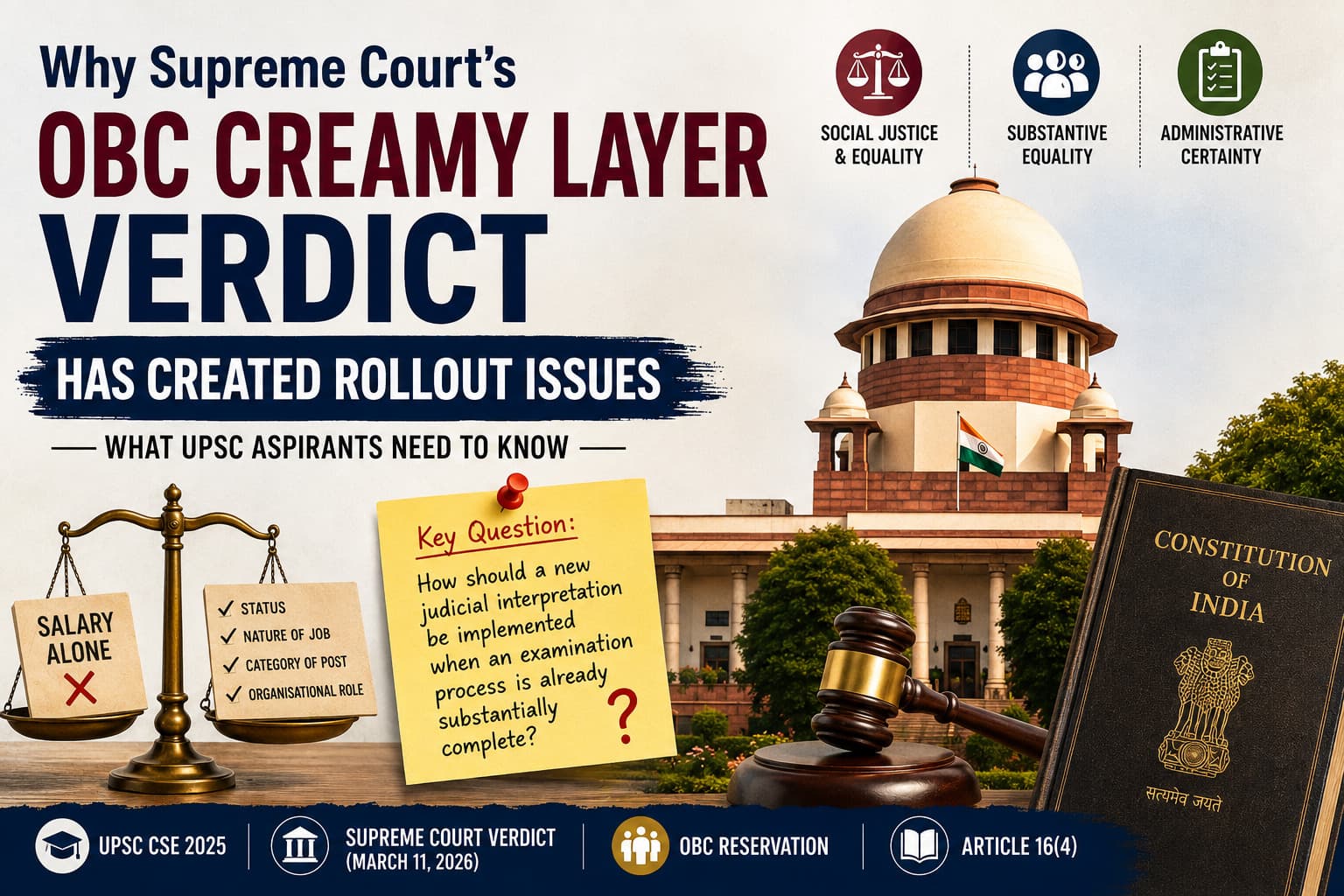
Why the Supreme Court’s OBC Creamy Layer Verdict Has Created Rollout Issues: What UPSC Aspirants Need to Know
Supreme Court’s OBC creamy layer verdict explained: why salary alone is insufficient and what it means for UPSC aspirants and CSE 2025.
Koach Team·31 August 2026
Introduction
The Supreme Court’s March 11, 2026 judgment on the OBC Creamy Layer has triggered an important debate over equality, reservation policy and administrative implementation.
The Court held that parental salary alone cannot be the sole basis for deciding whether an OBC candidate belongs to the creamy layer. The status and category of the posts held by the parents must also be considered.
While the judgment provides important constitutional clarity, its implementation has created a difficult practical problem—particularly for the UPSC Civil Services Examination (CSE) 2025.
The central question is no longer simply:
Who should be treated as creamy layer?
The bigger question is:
How should a new judicial interpretation be implemented when an examination and selection process has already substantially concluded?
What Is the OBC Creamy Layer?
The concept of the creamy layer refers broadly to the relatively advanced sections within the Other Backward Classes who are excluded from certain reservation benefits.
The objective is to ensure that reservation benefits reach sections that continue to face genuine social and educational disadvantage.
The creamy layer principle is linked to India's broader constitutional framework surrounding:
Equality
Social justice
Affirmative action
Equality of opportunity
The exclusion is intended to prevent relatively advanced sections from repeatedly monopolising the benefits of reservation.
The Supreme Court held that parental salary alone cannot automatically determine creamy layer status.
The Court emphasised that the following factors are also important:
Status of the parents
Nature of employment
Category of post
Professional position
Organisational hierarchy
In simple words:
Salary alone is not always enough to determine social advancement.
A person's income may indicate economic advancement, but creamy layer determination cannot completely ignore the larger social and professional position of the parents.
Why Is This Judgment Important?
Consider two families.
Family A
A parent works as a senior government officer with substantial authority and a high position in the administrative hierarchy.
Family B
A parent works in the private sector and earns a similar salary but does not have the same institutional authority, social position or service status.
If the system looks only at salary, both families could potentially be treated similarly.
But if the objective is to identify genuine social advancement, income alone may not capture the entire picture.
Therefore, the Supreme Court stressed the importance of considering status and the category of posts held by parents, rather than mechanically relying only on salary.
The Biggest Problem: How Do You Compare Different Jobs?
This is where the real implementation challenge begins.
Government services have a relatively structured hierarchy.
Posts can broadly be classified according to:
Group or category
Service level
Seniority
Administrative authority
But what happens in the private sector?
A person called a Manager in one company may supervise five employees.
Another person with the same title in another company may manage a large division with hundreds of employees.
Similarly, positions in:
Government services
Public Sector Undertakings
Banks
Private companies
Autonomous organisations
may have completely different organisational structures.
Therefore, creating a uniform comparison mechanism becomes difficult.
Why Does This Matter for UPSC CSE 2025?
The timing of the judgment created the biggest complication.
The CSE 2025 examination process had already substantially progressed when the Supreme Court delivered its judgment.
This creates an important administrative question:
Should a new judicial interpretation be applied to a selection process that was already substantially complete?
The answer is not straightforward.
Why Is Retrospective Application Difficult?
Suppose the judgment is applied retrospectively to CSE 2025.
Several complications could arise.
1. Candidates May Have Chosen Their Category Based on Existing Rules
Some candidates may have believed that they were not eligible for OBC Non-Creamy Layer benefits under the interpretation prevailing during the examination process.
As a result, they may have competed under:
General category
Another applicable category
rather than claiming OBC-NCL benefits.
If the interpretation changes after the examination process, reopening the process could create questions of fairness.
2. Merit Lists Could Be Affected
Reservation categories directly influence:
Category-wise cut-offs
Merit positions
Service allocation
Number of candidates selected under different categories
Changing eligibility after results could potentially affect the entire selection matrix.
This means retrospective implementation is not simply about adding or removing a few candidates.
It could potentially require reconsideration of multiple stages of the selection process.
3. Training and Service Allocation Could Be Disrupted
Reopening a completed or nearly completed selection process could affect:
Training schedules
Batch strength
Cadre allocation
Service allocation
Seniority
Pay fixation
Therefore, administrative consequences could extend beyond individual candidates.
Does the Judgment Mean the Entire OBC Reservation System Has Changed?
No.
This is an important distinction.
The judgment does not eliminate the creamy layer principle.
The creamy layer principle remains an important part of the framework governing OBC reservation.
The key issue is the method used to determine whether a person belongs to the creamy layer.
The Supreme Court's approach challenges a mechanical system that relies solely on parental salary.
Instead, the larger context of social and professional status must also be considered.
The Constitutional Debate: Formal Equality vs Substantive Equality
This case is extremely important for UPSC aspirants because it highlights a deeper constitutional debate.
Formal Equality
Formal equality focuses on applying the same visible rule to everyone.
For example:
Anyone above a particular income level is treated according to the same criteria.
This approach is simple and easier to administer.
However, simplicity may sometimes ignore important social differences.
Substantive Equality
Substantive equality asks a deeper question:
Does the rule account for actual differences in social and structural conditions?
Two families earning the same income may not necessarily occupy the same:
Social position
Professional status
Institutional authority
Historical advantage
The Supreme Court's reasoning reflects this broader concern.
The goal is not merely to compare numbers.
The goal is to understand whether reservation benefits are reaching the sections for whom affirmative action is intended.
The Real Challenge: Equality Must Also Be Implementable
A policy can be constitutionally sound in principle but difficult to implement uniformly.
This is the central challenge in the current controversy.
A system based only on income may be easier to administer.
But it may sometimes produce unfair outcomes.
A system based on:
Income
Status
Nature of employment
Organisational hierarchy
Post equivalence
may provide a more nuanced assessment.
However, it is also much more difficult to implement consistently across:
Government services
PSUs
Banks
Private companies
Different industries
This creates a fundamental tension between:
Substantive Equality
and
Administrative Certainty
India's challenge is to design a framework that protects both.
Why This Case Matters for UPSC Aspirants
For UPSC aspirants, this issue is important beyond the immediate creamy layer controversy.
It is relevant to multiple areas of the syllabus.
GS Paper II
Important topics include:
Article 14
Article 15
Article 16
Article 16(4)
Equality of opportunity
Reservation policy
Social justice
Judicial review
Constitutional interpretation
Executive policy
Essay
Possible essay themes include:
Equality is not always achieved by treating everyone identically.
Social justice requires both fairness and administrative clarity.
The challenge of public policy is to convert constitutional ideals into workable institutions.
GS Paper IV – Ethics
The issue can also be analysed through:
Fairness
Equity
Justice
Impartiality
Public interest
Administrative responsibility
A government must not only create fair rules.
It must also ensure that those rules can be implemented consistently and predictably.
Key Terms UPSC Aspirants Should Remember
Creamy Layer
Relatively advanced sections within OBC communities who are excluded from certain reservation benefits under the applicable framework.
Non-Creamy Layer
Eligible sections within OBC communities that satisfy the applicable criteria for reservation benefits.
Substantive Equality
Equality that considers actual social and structural differences rather than applying identical treatment mechanically.
Formal Equality
Treating similarly placed individuals according to the same visible rule.
Article 16(4)
A constitutional provision enabling reservation in appointments or posts in favour of backward classes that are not adequately represented in state services.
Judicial Review
The power of constitutional courts to examine the legality and constitutionality of executive and legislative actions.
Administrative Certainty
The principle that government rules and decisions should be clear, predictable and consistently applied.
The Bigger Policy Question
The real challenge is not simply whether creamy layer exclusion is necessary.
The more difficult question is:
How should India objectively measure social advancement beyond mere income?
Income is relatively easy to calculate.
Social position is not.
Salary is measurable.
Status and social advancement can be far more complex.
Yet a constitutional system focused on substantive equality cannot always reduce every social question to a single financial number.
India may therefore need a transparent and uniform mechanism that can assess candidates fairly while remaining practical enough to implement across diverse employment structures.
What Happens Next?
The implementation of the Supreme Court's interpretation remains an important legal and administrative issue.
The outcome could potentially influence:
OBC candidates
UPSC Civil Services Examination processes
Future creamy layer determinations
PSU employees' children
Private-sector employees' children
Government policy
However, aspirants should avoid assuming that a judicial interpretation automatically changes eligibility for every candidate or every examination cycle.
The implementation framework and timing remain equally important.
TryKoach Takeaway 🎯
The Supreme Court's OBC creamy layer judgment is not just about an income limit.
It raises a much larger question about how India defines social advancement.
The judgment highlights an important principle:
Economic income and social status are not always the same thing.
At the same time, the government faces a genuine implementation challenge.
A reservation policy must pursue social justice, but its application must also be:
Clear
Uniform
Predictable
Fair
Administratively workable
The ultimate challenge is to build a system that achieves:
Substantive Equality without creating Administrative Uncertainty.
UPSC Mains Practice Question
“The determination of social advancement cannot always be reduced to economic indicators alone. Examine in the context of the Supreme Court's approach to the OBC creamy layer principle.”