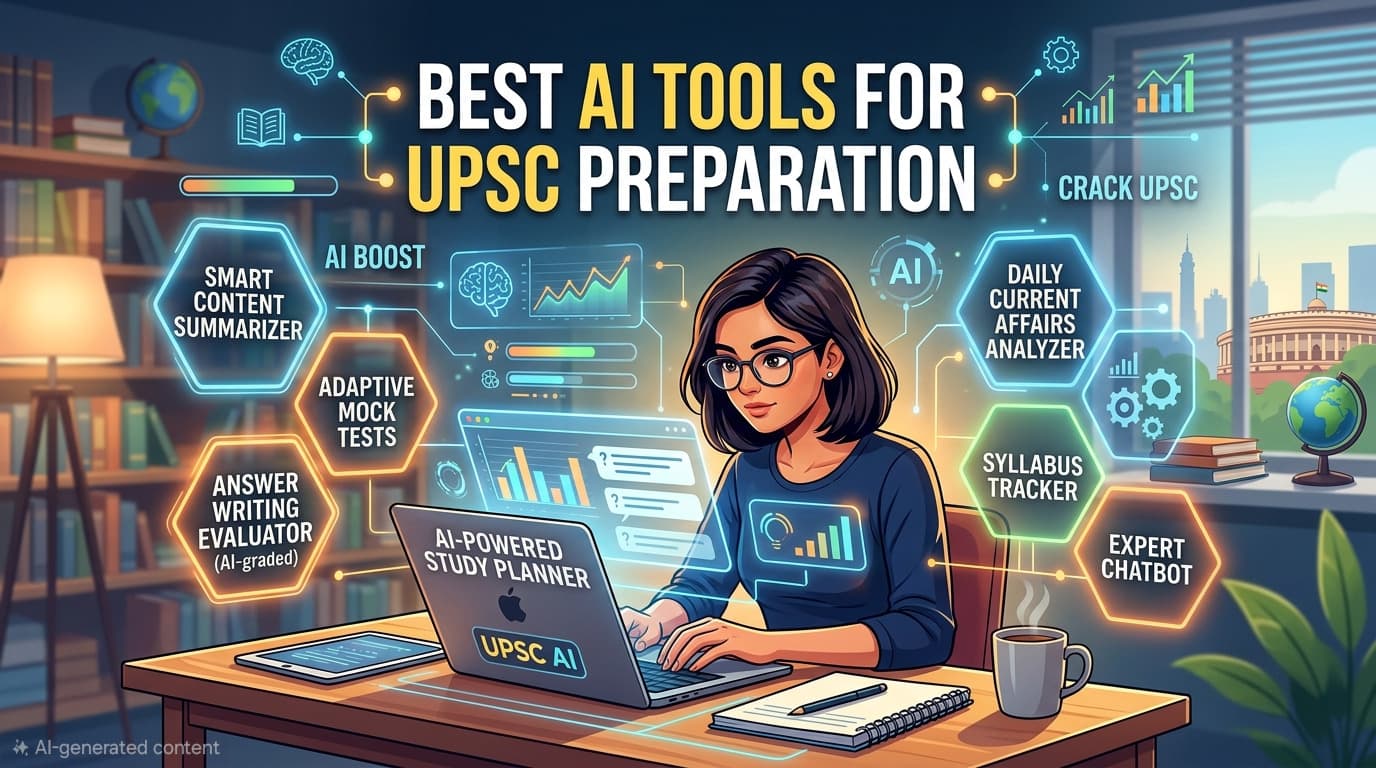
Best AI Tools for UPSC Preparation in 2026: 7 AI Tools That Actually Help
Discover the best Al tools for UPSC Preparation 2026, including ChatGPT, Gemini, Perplexity, NotebookLM, SuperKalam, Vaidra and TryKoach.
Koach Team·7 October 2026
Preparing for UPSC in 2026 is no longer only about collecting books, reading newspapers, and joining a test series.
Artificial Intelligence has become a useful study assistant for UPSC aspirants. AI can help you understand difficult concepts, analyse current affairs, generate practice questions, review answers, summarise study material, and identify areas where you are repeatedly making mistakes.
But there is a problem.
There are now hundreds of AI tools, and almost every platform claims to be the "best AI tool for UPSC."
The truth is simpler:
«No single AI tool is best at everything.»
ChatGPT can be useful for explaining concepts and practising answer writing. Perplexity can help with current-affairs research and source discovery. NotebookLM is useful for studying your own PDFs and notes. Dedicated UPSC platforms can provide exam-specific practice, evaluation, and analytics.
So the right question isn't:
«Which AI tool is the best for UPSC?»
It is:
«Which AI tool is best for each part of my UPSC preparation?»
This guide compares seven useful AI tools and explains where each one fits.
Quick Comparison: Best AI Tools for UPSC 2026
AI Tool| Best For| Best Stage
ChatGPT| Concepts, brainstorming, answer practice| Prelims + Mains
Google Gemini| Long documents, research and explanations| Prelims + Mains
Perplexity| Current affairs and source-based research| Prelims + Mains
NotebookLM| Studying your own PDFs and notes| All stages
SuperKalam| AI-assisted UPSC learning and mentorship| Prelims + Mains
Vaidra| UPSC-specific AI practice and evaluation| Prelims + Mains
TryKoach| MCQs, PYQs, current affairs, Mains practice and analytics| Prelims + Mains
The important point is that these tools solve different problems.
ChatGPT — Best for Understanding Concepts
ChatGPT is one of the most flexible AI tools an UPSC aspirant can use.
You can ask it to explain a difficult concept at different levels.
«"Explain quantitative easing like I'm a beginner."»
Then:
«"Now explain quantitative easing at UPSC Mains level."»
Then:
«"Give me 5 UPSC-style MCQs on quantitative easing."»
And finally:
«"Give me a 150-word Mains question on this topic and evaluate my answer."»
Best uses for UPSC
Understanding difficult concepts
Simplifying textbooks
Generating practice questions
Brainstorming essay topics
Ethics case studies
Mains answer structure
Interview practice
Revision
Creating study plans
Example Prompt
Explain India's federal structure for UPSC.
First explain the concept simply, then give constitutional provisions,
important Supreme Court judgments, contemporary examples,
and finally ask me 5 Prelims questions.
Limitation
Do not blindly trust AI-generated facts.
AI can sometimes produce incorrect dates, statistics, constitutional provisions, or references. Current-affairs information should be checked against reliable primary or established sources.
Use AI to improve your thinking. Verify important facts independently.
Google Gemini — Best for Long Documents and Research
Google Gemini is another general-purpose AI assistant that can be useful for UPSC preparation.
One useful application is working with large amounts of information.
For example, an aspirant can use AI to understand:
Government reports
Policy documents
Research material
Long articles
Reports and studies
Complex topics
Instead of asking:
«"Summarise this."»
Try:
«"Extract the five most important points from this report for UPSC GS2. Separate factual information from analytical arguments and give me possible Prelims and Mains questions."»
This produces much more useful preparation material.
Best Uses
Long-document analysis
Policy research
Concept explanation
Current-affairs analysis
Comparing policies
Brainstorming
Revision
Limitation
Like other general-purpose AI systems, Gemini should not be treated as an unquestionable source of truth.
For important UPSC facts, always cross-check.
Perplexity — Best for Current Affairs Research
Current affairs are one area where source verification is extremely important.
This is where Perplexity can be useful.
Instead of simply asking:
«"What happened in India's economy today?"»
you can ask:
«"What were the most important Indian economy developments today that could be relevant for UPSC? Give primary or highly credible sources for every major claim."»
The major advantage is that the tool provides sources that you can open and inspect.
This is particularly useful for researching:
Government schemes
Supreme Court judgments
International relations
Economic developments
Environment
Science and technology
Government announcements
International organisations
Best Workflow
Find → Verify → Understand → Make Notes → Practice
Don't do:
Find → Copy → Memorise
Limitation
A citation does not automatically mean the information is correct.
Open the source and verify important claims.
NotebookLM — Best for Your Own Study Material
NotebookLM is different from a normal chatbot because its biggest strength is working with the material you provide.
For example, you could provide:
NCERT PDFs
Your class notes
Government reports
ARC reports
NITI Aayog documents
Newspaper compilations
Coaching material
Then ask questions based on those sources.
For example:
«"Based only on these documents, explain the causes of the Green Revolution."»
Or:
«"Create 15 revision questions from these notes."»
This can be extremely useful because you are working from a controlled set of sources rather than asking a general AI to recall information from its broader knowledge.
Best Uses
PDF study
Revision
Summarisation
Question generation
Connecting information across documents
Revising your own notes
Limitation
The quality of the output depends on the quality of the material you provide.
Good sources in → Better study material out.
SuperKalam — Best for a Dedicated UPSC AI Experience
Unlike general-purpose AI assistants, SuperKalam is designed specifically around UPSC preparation.
Dedicated platforms can be useful because the user doesn't have to spend time explaining the UPSC syllabus, exam pattern, or desired question style in every interaction.
SuperKalam is one of the dedicated UPSC AI platforms available for structured UPSC preparation, AI tutoring, and practice.
Best For
UPSC-focused learning
Structured preparation
AI-assisted practice
Current affairs
Guided preparation
Who Should Consider It?
An aspirant who prefers a structured UPSC-specific environment rather than using a general chatbot for everything.
Vaidra — Best for UPSC-Specific AI Evaluation
Vaidra is another dedicated UPSC AI platform.
Its offering focuses on UPSC-specific features such as AI-based doubt resolution, Mains evaluation, PYQ-based practice, and current affairs.
Best For
UPSC-specific AI assistance
Mains answer evaluation
PYQ practice
Current affairs
Personalised preparation
What Makes Dedicated Platforms Different?
The important difference is context.
A general AI knows a huge amount of information.
A UPSC-specific platform is designed around the examination.
For an aspirant, that can reduce the amount of prompting and manual organisation required.
TryKoach — Best for AI-Powered UPSC Practice
TryKoach takes a slightly different approach.
It is not designed simply to give you another place to consume UPSC content.
Its core idea is:
«Study → Practice → Analyse → Improve»
TryKoach combines AI practice with real UPSC PYQs, current-affairs quizzes, Mains writing, analytics, revision, and an AI mentor.
AI-Powered MCQ Practice
Generate UPSC-style MCQs on specific topics and practise them immediately.
For example:
Indian Polity
→ Parliament
→ 10 Questions
→ Medium Difficulty
The system creates a practice session around the selected topic.
Real UPSC PYQs
AI-generated questions are useful, but they should not replace actual UPSC questions.
TryKoach provides a large collection of real UPSC Prelims PYQs with explanations and filters for structured practice.
This gives you two types of practice:
AI-generated questions → More practice
Real UPSC PYQs → Understand the actual UPSC pattern
Both are important.
Daily Current Affairs Practice
Reading current affairs is only half the job.
The other half is remembering and applying what you read.
TryKoach's current-affairs practice converts important developments into UPSC-style questions with explanations.
This creates a simple cycle:
Read → Attempt → Check → Learn → Revise
Instead of simply consuming current affairs, you actively test your understanding.
AI Mains Answer Evaluation
Reading Mains answers is not enough.
You need feedback.
TryKoach's Mains practice can help aspirants evaluate answers across areas such as:
Introduction
Structure
Content
Examples
Factual accuracy
Conclusion
Relevance to the question
The objective isn't simply:
«"Your answer is good."»
It should be:
«"Here is where you lost marks and what you should improve."»
That distinction matters.
AI Mentor and Performance Analysis
Another useful approach is connecting AI assistance with your practice history.
Instead of asking:
«"What should I study?"»
you can ask:
«"Which areas am I weak in?"»
Performance data can help identify:
Weak subjects
Repeated mistakes
Low-accuracy topics
Revision gaps
Progress over time
This moves AI from simple:
Question answering
towards:
Performance-based guidance.
Which AI Tool Should You Use?
There is no reason to use every tool.
Choose according to your problem.
Your Requirement| Recommended Tool
Understand difficult concepts| ChatGPT / Gemini
Research current affairs| Perplexity
Study your own PDFs| NotebookLM
Dedicated UPSC AI learning| SuperKalam / Vaidra
AI-generated MCQ practice| TryKoach
Real UPSC PYQ practice| TryKoach
Performance-based practice| TryKoach
Mains answer evaluation| TryKoach / Dedicated UPSC AI platforms
The Best AI Stack for a UPSC Aspirant
You don't need seven AI subscriptions.
A simple workflow can be much more effective.
Step 1 — Learn
Use standard books, classes, NCERTs, and reliable sources.
Step 2 — Understand
Use ChatGPT or Gemini when a concept is confusing.
Step 3 — Research
Use Perplexity and primary sources for current affairs.
Step 4 — Study Your Material
Use NotebookLM when you want to work deeply with your own PDFs and notes.
Step 5 — Test Yourself
Use TryKoach for AI-generated MCQs and real UPSC PYQs.
Step 6 — Analyse
Look at:
Accuracy
Weak subjects
Repeated mistakes
Time taken
Topic-wise performance
Step 7 — Revise
Revisit topics where you repeatedly make mistakes.
Step 8 — Write
Practise Mains answers regularly and use AI evaluation to identify weaknesses.
Instead, use AI to reduce low-value work and increase high-value practice.
A good UPSC aspirant should spend less time asking:
«"What should I study?"»
and more time asking:
«"Can I actually answer the question?"»
The Biggest Mistake: Using Too Many AI Tools
You don't need ChatGPT, Gemini, Perplexity, NotebookLM, and five UPSC apps every day.
That creates another problem:
Tool overload.
Your notes become scattered.
Your study history gets fragmented.
You spend more time comparing tools than preparing for UPSC.
A better approach is:
One tool for explanation
One tool for research
One tool for practice
For example:
ChatGPT → Understand
Perplexity → Research
TryKoach → Practice
That's enough for many aspirants.
Final Verdict: Which Is the Best AI Tool for UPSC in 2026?
There is no universal winner.
The best tool depends on what you are trying to accomplish.
ChatGPT is an excellent general-purpose study assistant.
Gemini is useful for research and working with large amounts of information.
Perplexity is particularly useful for source-based current-affairs research.
NotebookLM is powerful when your preparation revolves around your own documents.
SuperKalam and Vaidra provide dedicated UPSC-focused AI experiences.
TryKoach is particularly useful when the goal is to practice, measure, and improve actual exam readiness through AI MCQs, real PYQs, current-affairs practice, Mains answer writing, analytics, revision, and AI-assisted guidance.
Frequently Asked Questions
Which is the best AI tool for UPSC preparation in 2026?
There is no single best tool for every task. ChatGPT and Gemini are useful for general learning, Perplexity for source-based research, NotebookLM for personal study material, while dedicated platforms such as SuperKalam, Vaidra, and TryKoach focus specifically on UPSC preparation.
Can AI replace UPSC coaching?
No. AI can support learning, revision, testing, and feedback, but it should not replace standard books, reliable sources, PYQs, answer writing, and disciplined preparation.
Which AI tool is best for UPSC current affairs?
Perplexity can be useful for researching current events because it provides sources that can be checked. A dedicated practice platform such as TryKoach can then be used to turn current affairs into UPSC-style questions.
Which AI tool is best for UPSC MCQs?
TryKoach is designed around UPSC practice, including AI-generated MCQs and real UPSC PYQs.
Can AI evaluate UPSC Mains answers?
Yes. Several dedicated UPSC AI platforms provide answer evaluation. AI-based evaluation can help identify weaknesses in structure, content, examples, relevance, and conclusion.
Should UPSC aspirants use multiple AI tools?
Yes, but selectively. Using a small number of tools for clearly different purposes is better than constantly switching between many platforms.
Final Takeaway
AI won't replace the hard work required for UPSC.
But it can make that hard work more targeted.
Don't use AI to study more.
Use AI to study better, practise more intelligently, and find your weaknesses faster.