UPSC Mains 2026 GS Paper 3: Complete Question Paper, Analysis, Difficulty Level & Key Preparation Insights
Koach Team25 August 2026
UPSC Mains 2026 GS Paper 3: Complete Question Paper, Analysis, Difficulty Level & Key Insights
UPSC Mains 2026 GS Paper 3: Overview
The UPSC Civil Services Mains 2026 General Studies Paper 3 (GS Paper 3) covered major areas of the UPSC syllabus, including Indian Economy, Agriculture, Science & Technology, Environment, Disaster Management, and Internal Security.
The paper consisted of 20 compulsory questions:
- Questions 1–10: 150 words each
- Questions 11–20: 250 words each
The paper placed significant emphasis on connecting static concepts with current affairs, government policies, technology, sustainability, and national security.
UPSC Mains 2026 GS Paper 3 Questions
Questions 1–10: 150 Words
Q1. Digital Rupee and CBDC
What do you mean by Digital Rupee? Explain the working and progress of India's Central Bank Digital Currency (CBDC).
Q2. Financial Inclusion
Examine the view that financial inclusion is an integral part of social and economic inclusion in India. Discuss the usefulness of the RBI's Financial Inclusion Index.
Q3. Technology Missions in Agriculture
Describe the various technology missions initiated in Indian agriculture and examine their role in food security.
Q4. Agricultural Marketing
Explain the factors responsible for inefficiency in agricultural-produce marketing. How can e-commerce help reduce these inefficiencies?
Q5. Biotechnology and Agriculture
Explain, with two examples, how biotechnology has helped Indian farmers in processing their perishable crops.
Q6. Fast Breeder Reactors
Distinguish between a Fast Breeder Reactor (FBR) and a thermal nuclear reactor. Explain the term 'criticality' in the context of the indigenous prototype FBR at Kalpakkam and discuss its implications for India's clean-energy future.
Q7. Infrastructure and Disaster Risk Reduction
Discuss how the contradiction between rapid infrastructure development and disaster-risk reduction in ecologically sensitive areas of India can be managed, with suitable examples.
Q8. Kunming-Montreal Global Biodiversity Framework
Discuss the aims and goals of the Kunming-Montreal Global Biodiversity Framework. Mention India's commitments and initiatives to achieve its targets.
Q9. Fake News and Internal Security
Explain how fake news and misinformation pose a threat to internal security and public order in India. Discuss the salient features of amendments under the Information Technology Rules, 2021.
Q10. Ladakh and Border Area Development
Discuss the Border Area Development Programme (BADP), civic actions by the Army, and the demand for Sixth Schedule provisions for Ladakh.
Questions 11–20: 250 Words
Q11. Energy Security
Explain the key challenges to India's energy security. Suggest measures for ensuring energy security alongside economic growth and sustainability.
Q12. Indian Startups
Explain how startups in India promote entrepreneurship, innovation, and employment. Discuss global and domestic challenges and suggest suitable measures to overcome them.
Q13. Agricultural Transformation
Explain how Indian agriculture has transformed from food scarcity to food surplus. Discuss government policies implemented for diversification of Indian agriculture.
Q14. Agricultural Subsidies and WTO
Discuss the different types of subsidies and support provided by the Government of India to agriculture. Examine issues related to the WTO Agreement on Agriculture.
Q15. Mission Drishti
Mention the salient features of Mission Drishti. Discuss the imaging techniques used in the satellite launched on 3 May 2026 and explain why it is considered the world's first satellite of its kind.
Q16. Agentic Artificial Intelligence
What is Agentic Artificial Intelligence (AI)? Explain its working and applications with suitable examples. Discuss its advantages, risks, and challenges.
Q17. Solid Waste Management
Discuss the challenges of solid waste management in India. Explain the government policy framework and highlight successful waste-management initiatives in Delhi and Indore.
Q18. Community Participation in Disaster Management
"Community participation is the cornerstone of effective disaster management." Analyse this statement with suitable examples from India. Discuss challenges and measures to strengthen community participation.
Q19. Jammu & Kashmir
Discuss separatist movements and government actions to bring Jammu & Kashmir into the national mainstream. Explain the pre- and post-abrogation status of Articles 370 and 35A and the positive impacts of the changes.
Q20. Terror Financing
Discuss counterfeit currency and money laundering as major sources of terror financing in India. Explain international actions to address these threats and highlight the role of the Financial Action Task Force (FATF).
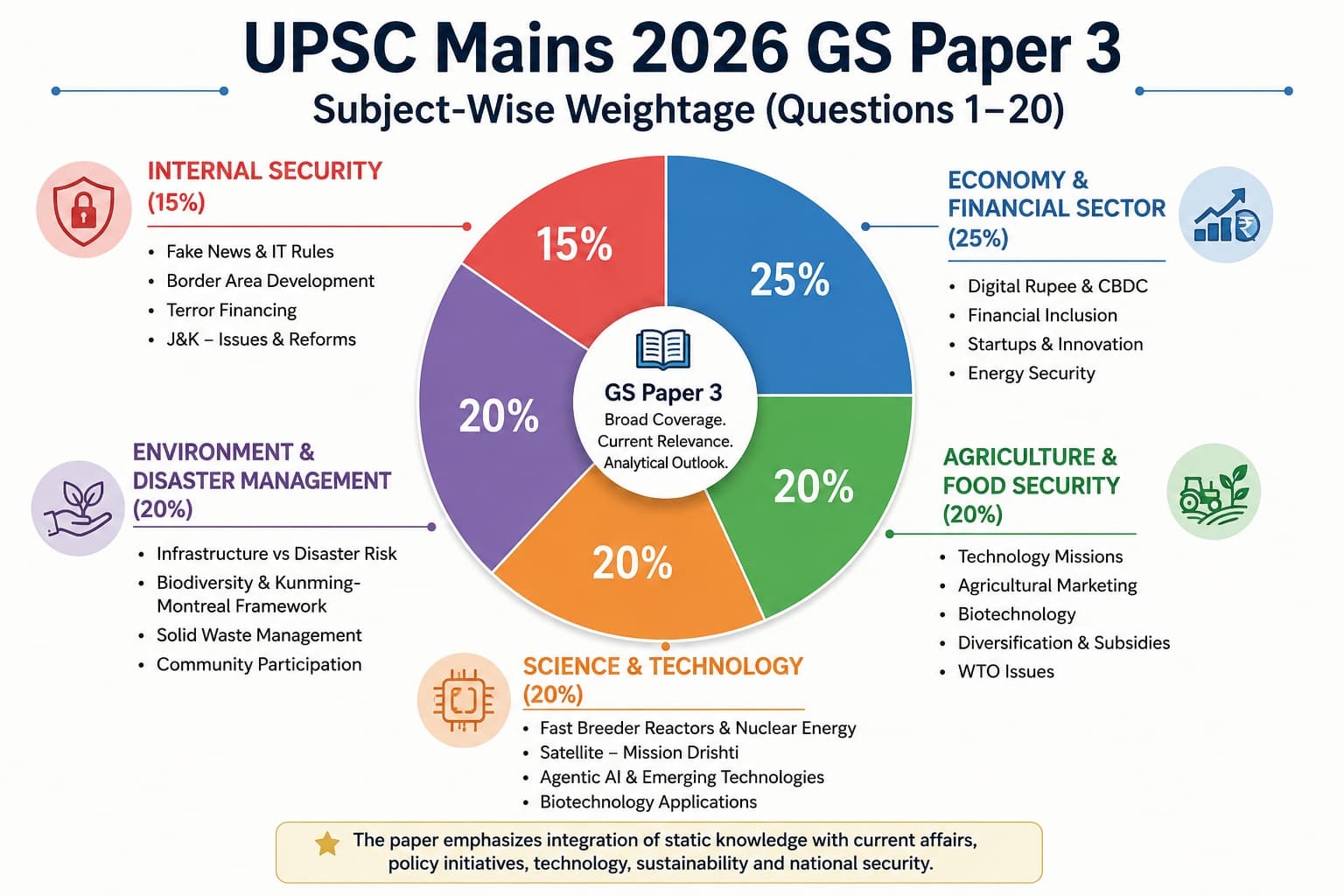
UPSC Mains 2026 GS Paper 3: Subject-Wise Analysis
1. Economy and Financial Sector
The economy section focused on emerging financial technologies, financial inclusion, entrepreneurship, and energy security.
Key themes included:
- Digital Rupee and CBDC
- Financial inclusion
- RBI Financial Inclusion Index
- Startup ecosystem
- Energy security
A useful framework for Economy answers is:
Concept → Current Status → Benefits → Challenges → Way Forward
2. Agriculture and Food Security
Agriculture was an important component of GS Paper 3.
Major themes included:
- Technology missions in agriculture
- Food security
- Agricultural marketing
- E-commerce
- Biotechnology
- Crop diversification
- Agricultural subsidies
- WTO issues
The paper tested agriculture beyond the traditional focus on production. Aspirants needed to connect agriculture with farmer income, technology, value addition, market access, sustainability, and global trade.
3. Science and Technology
The Science and Technology section focused on emerging technologies and strategic innovation.
Important areas included:
- Fast Breeder Reactors
- Nuclear energy
- Satellite imaging
- Biotechnology
- Artificial Intelligence
- Agentic AI
A useful framework is:
Technology → Working → Applications → Benefits → Risks → Regulation
4. Environment and Disaster Management
The environment section focused on balancing development with ecological sustainability and disaster resilience.
Major themes included:
- Infrastructure development in ecologically sensitive areas
- Disaster-risk reduction
- Biodiversity conservation
- Kunming-Montreal Global Biodiversity Framework
- Solid waste management
- Community participation
Strong answers should integrate:
- Environmental principles
- Government policies
- Relevant examples
- Local case studies
- Sustainable solutions
5. Internal Security
The Internal Security section covered contemporary security challenges and institutional responses.
Important areas included:
- Fake news and misinformation
- Digital media regulation
- Border-area development
- Terror financing
- Counterfeit currency
- Money laundering
- FATF
These questions required candidates to connect security challenges with technology, finance, governance, and institutional mechanisms.
UPSC Mains 2026 GS Paper 3 Difficulty Level
The overall difficulty of GS Paper 3 can be considered moderate to challenging.
The paper was demanding because of:
- Strong integration of current affairs
- Application-based questions
- Interdisciplinary themes
- Policy-oriented questions
- Requirement to connect static concepts with contemporary developments
Candidates who consistently practised linking static knowledge with current affairs, government schemes, examples, and policy solutions would have had an advantage.
Key Preparation Lessons From UPSC GS Paper 3 2026
1. Prepare Economy Through Issues
Instead of memorising economic definitions, prepare topics using:
Concept → Government Initiative → Impact → Challenges → Way Forward
2. Connect Agriculture With Technology and Markets
Agriculture preparation should cover:
- Productivity
- Technology adoption
- Farmer welfare
- Supply chains
- Market access
- Value addition
- Sustainability
3. Track Emerging Technologies
For Science and Technology, focus on:
- How the technology works
- Applications
- Benefits
- Limitations
- Ethical concerns
- Regulatory challenges
4. Build a Case-Study Bank
Environment and Disaster Management answers can be strengthened through examples involving:
- Waste-management models
- Community-based disaster response
- Biodiversity conservation
- Sustainable infrastructure
- Disaster-resilient development
5. Develop a Security-Oriented Framework
For Internal Security questions, structure answers around:
Threat → Causes → Impact → Existing Mechanisms → Gaps → Reforms
What Does GS Paper 3 2026 Tell Future Aspirants?
The paper demonstrates that UPSC is increasingly testing the ability to connect different dimensions of a topic rather than simply reproduce factual information.
For example, a question on Agentic AI requires understanding not only of technology but also of:
- Applications
- Employment
- Ethics
- Cybersecurity
- Governance
- Regulation
Similarly, agriculture questions increasingly require an understanding of:
- Technology
- Markets
- Farmer income
- Food security
- Sustainability
- Global trade
Therefore, preparation should become increasingly interdisciplinary and application-oriented.
How to Prepare GS Paper 3 After UPSC Mains 2026
Aspirants should organise their preparation around five broad pillars:
- Static Concepts — Build strong conceptual foundations.
- Current Affairs — Track major developments related to the syllabus.
- Government Initiatives — Understand schemes, policies, missions, and institutional mechanisms.
- Examples and Case Studies — Maintain a ready-to-use database for answer writing.
- Answer Writing — Practise analytical, multidimensional, and solution-oriented answers.
The goal should not be to memorise more information. The goal should be to use information effectively in an answer.
Conclusion
UPSC Mains 2026 GS Paper 3 reflects the examination's increasing emphasis on technology-driven development, sustainable growth, agricultural transformation, and national security.
The paper shows that future aspirants need to move beyond isolated subject preparation and develop an integrated understanding of contemporary issues.
A strong GS Paper 3 answer increasingly requires:
Conceptual Clarity + Current Affairs + Government Policies + Examples + Analysis + Practical Solutions
For future aspirants, the UPSC Mains 2026 GS Paper 3 question paper should be treated not merely as a test paper, but as an important indicator of the themes, depth, and analytical approach expected in GS Paper 3.