India’s Degree-to-Job Gap: What the NITI Aayog Report Means for UPSC Aspirants
NITI Aayog’s latest report highlights India’s education-employment gap. Explore the key data, skill mismatch, reforms and UPSC GS-II, GS-III and Essay perspectives.
Koach Team·27 August 2026
Why this is more than a debate over BA, B.Sc. and B.Com
A degree is supposed to expand economic opportunity. But what happens when millions of young Indians spend years in higher education and still struggle to find work that matches what they studied?
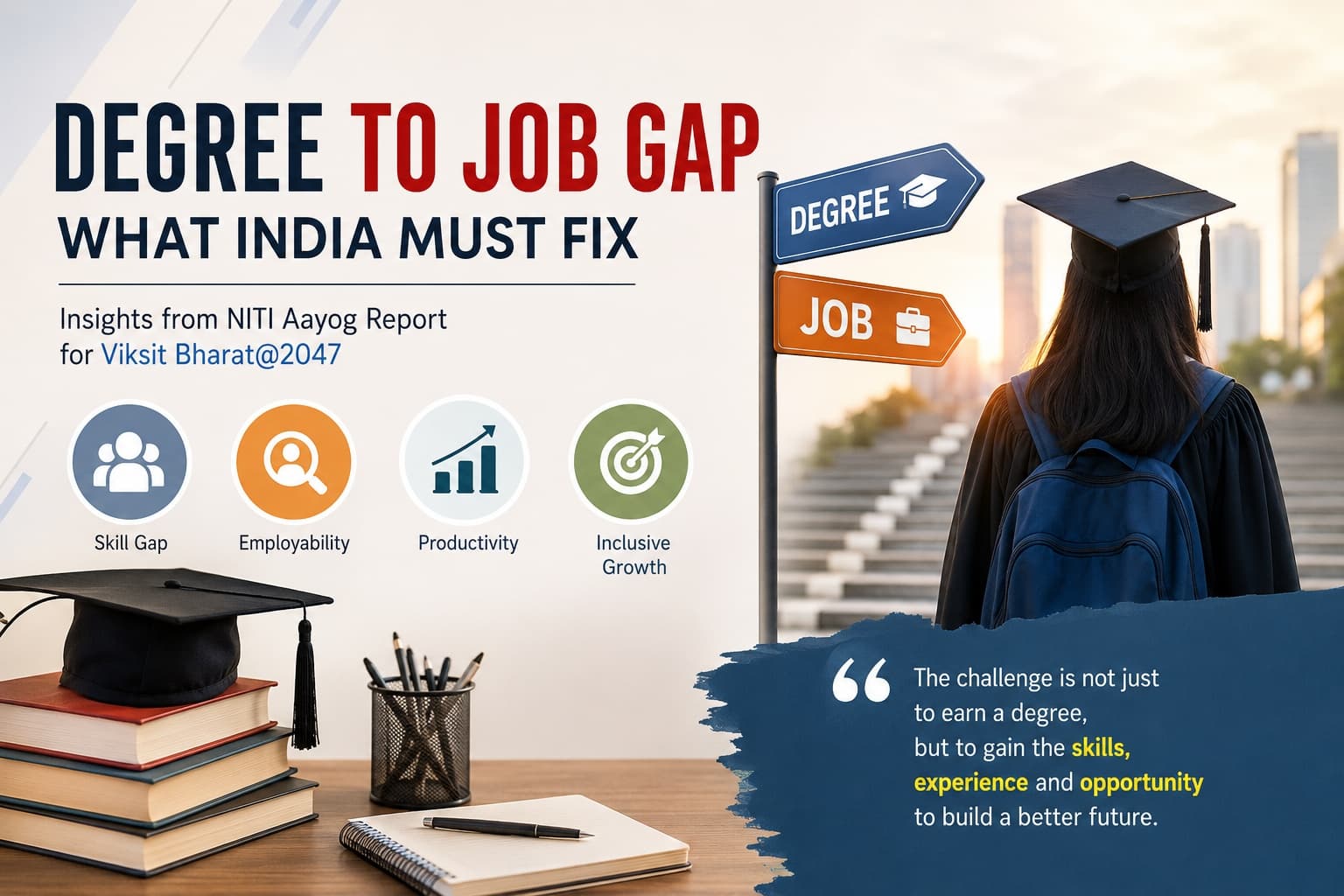
This question has gained fresh importance after NITI Aayog’s report, “Reimagining Skilling for Viksit Bharat@2047”, highlighted a structural disconnect between India’s education system and the labour market. The report argues that many conventional or “generic” degree programmes have weak direct links with employment and calls for stronger integration of education, skills, apprenticeships and industry demand.
For UPSC aspirants, this is not merely an education story. It connects directly with employment, human capital, demographic dividend, women’s participation in the workforce, skilling, vocational education, productivity and inclusive growth.
The Numbers That Should Make Policymakers Uncomfortable
NITI Aayog draws attention to several indicators of the education–employment mismatch.
According to the report, only 8.25% of graduates are employed in roles aligned with their qualifications. The figure is drawn from the Economic Survey 2024–25.
At the same time, graduate unemployment is reported at 13%, while unemployment among graduate women is 20.4%, compared with a national unemployment rate of 3.2% in the cited dataset.
The scale of enrolment in conventional undergraduate programmes is also significant. Of around 3.4 crore students enrolled in undergraduate programmes, 1.13 crore are enrolled in B.A. programmes alone, while combined enrolment in B.A., B.Sc. and B.Com exceeds 2 crore.
The report also notes that many young people choose generic degrees partly because they preserve eligibility for government recruitment. This creates a mismatch between aspirations and the limited number of formal government vacancies.
This is therefore not simply an unemployment problem. It is also a problem of career pathways and the economic returns to education.
The Real Problem Is Not That General Degrees Have No Value
This distinction is extremely important.
A B.A., B.Sc. or B.Com degree is not inherently worthless. The deeper issue is that a general academic qualification may not, by itself, communicate a clear set of workplace capabilities.
A student may graduate with a degree in economics, political science, history or commerce, but the labour market may simultaneously demand capabilities such as digital tools, data handling, communication, financial software, applied technology, problem-solving and workplace experience.
The problem, therefore, is the gap between:
Credential → Skill → Employability → Employment
When these links are weak, simply increasing enrolment in higher education does not automatically generate better employment outcomes.
NITI Aayog identifies outdated curricula, insufficient practical exposure and weak industry alignment as major contributors to this disconnect.
Why This Matters for India’s Demographic Dividend
India’s demographic advantage can become a demographic burden if education does not translate into productive economic participation.
A young population creates an opportunity only when people have:
Relevant skills
Access to jobs
Mobility between education and work
Opportunities for entrepreneurship and self-employment
The ability to adapt as technology changes
This is why skilling policy cannot be treated as a separate issue from higher education policy.
The objective should be to build an ecosystem in which education creates foundational knowledge, skilling creates job-ready capability, and work experience converts capability into productivity.
That is the larger significance of the NITI Aayog report.
The NEET Issue: An Important Clarification for UPSC
Another figure from the report received widespread attention: 8.7 crore young people aged 15–29 were classified as NEET — Not in Education, Employment or Training.
However, aspirants must be careful here.
The NEET category should not be interpreted as 8.7 crore unemployed youth. It includes people who are not in education, employment or training and may also include those who are not seeking employment.
The estimate is based on the 78th Round of the National Sample Survey, conducted in 2021, during the COVID-19 period.
UPSC Concept
NEET ≠ Unemployment
A person outside the labour force and not seeking employment is conceptually different from a person who is unemployed but actively available for or seeking work.
UPSC often tests precisely these kinds of conceptual distinctions.
What Reforms Is NITI Aayog Proposing?
The report’s approach is broader than simply adding more short-term skill courses.
1. Redesign Generic Degrees
NITI Aayog argues for transforming conventional degrees into more industry-aligned applied programmes.
Illustrative examples include:
B.A. Hospitality
B.Sc. Applied Technology
B.Com. Analytics
The objective is not to eliminate liberal education but to create stronger pathways between academic learning and occupational capability.
2. Expand Apprenticeships and Work-Integrated Education
One of the strongest recommendations is to scale Apprenticeship Embedded Degree Programmes (AEDP) and Work-Integrated Degree Programmes (WIDP).
This addresses a major weakness in India’s traditional education model: students often encounter the workplace only after completing their education.
Work-integrated pathways attempt to combine learning with actual work exposure.
3. Shift From Enrolment to Outcomes
A skilling programme should not be judged simply by:
How many people enrolled?
It should also be judged by:
Did they get work? Did incomes rise? Did they progress in their careers?
The focus therefore needs to shift towards demand-driven, outcome-linked and industry-backed skilling programmes.
4. Make Learning More Flexible
The report supports more flexible models such as:
Modular learning
Part-time learning
Hybrid learning
Earn-while-you-learn pathways
It also discusses mechanisms such as the National Credit Framework and a Digital Skills Passport to make learning and skills more portable across different pathways.
5. Introduce Vocational Exposure Earlier
India also needs stronger vocational and employability exposure during school years rather than waiting until graduation.
Students should understand the world of work before making major educational and career decisions.
Why Are General Degrees Still So Popular?
The answer is partly economic and partly social.
For many families, a general degree is:
Relatively accessible
Geographically available
Cheaper than professional education
Compatible with preparation for competitive examinations
Socially more acceptable than many vocational alternatives
NITI Aayog also identifies a social stigma around vocational education, ITIs and diploma pathways, which causes many students and parents to treat these routes as “second-tier” options.
This produces an important policy paradox:
India may be expanding education while still under-valuing the forms of education most directly connected to employment.
The Gender Dimension
The issue becomes sharper for women.
The report puts graduate women’s unemployment at 20.4% in the cited dataset, considerably above the overall graduate figure.
The challenge is not limited to education. Women’s employment is also affected by:
Safety concerns
Social norms
Mobility constraints
Time constraints
Care responsibilities
Lack of suitable employment opportunities
Uncertainty about employment outcomes
Thus, improving women’s employment requires more than education.
It requires:
Education + Skills + Safe Mobility + Suitable Jobs + Supportive Social Conditions + Flexible Work Opportunities
This makes the issue relevant to women’s empowerment, labour force participation and inclusive growth.
What Should India Do?
A better approach would be to move from a degree-centric model towards a capability-centric model.
Education Should Provide Foundations
Universities should continue to develop:
Analytical thinking
Knowledge
Communication
Research ability
Critical reasoning
Social and constitutional awareness
Skilling Should Provide Application
Students should also gain:
Digital skills
Sector-specific capabilities
Workplace readiness
Financial and entrepreneurial literacy
Practical experience
Industry Should Become Part of the Learning Ecosystem
Companies should have a greater role in:
Curriculum design
Apprenticeships
Internships
Assessment
Recruitment pipelines
Government Should Measure Outcomes
Public investment should increasingly be linked to:
Employment → Income → Productivity → Career Progression
rather than merely:
Enrolment → Certification
The UPSC Angle
This issue can be used across multiple parts of the syllabus.
Prelims
Focus on:
NITI Aayog
Reimagining Skilling for Viksit Bharat@2047
NEET terminology
NSS 78th Round
National Credit Framework
Apprenticeship-based programmes
Vocational education
GS Paper II
Link it with:
Education governance
Human capital
Skill development
Women’s empowerment
Demographic dividend
GS Paper III
This is the strongest linkage:
Employment
Labour markets
Skill mismatch
Productivity
Demographic dividend
Formalisation
Future of work
Essay
Possible themes:
“Education without employability: Can India convert its demographic advantage into a productive workforce?”
or
“A degree is a credential; capability is capital.”
A Balanced Mains Argument
A good UPSC answer should avoid the simplistic conclusion that “BA, B.Sc. and B.Com are bad degrees.”
A stronger argument is:
India’s problem is not mass higher education itself, but the weak conversion of educational credentials into market-relevant skills, productive employment and higher incomes.
General education remains important for building human capital and democratic citizenship. But it needs stronger bridges to vocational learning, apprenticeships, digital capabilities, entrepreneurship and industry.
This is exactly the kind of issue where a current-affairs fact becomes useful only when you can convert it into an analytical argument.
Practise This as a UPSC Mains Answer
Question
“India’s challenge is no longer merely creating access to higher education, but ensuring that education translates into employability and productive employment.” Discuss in the context of the NITI Aayog report on skilling for Viksit Bharat@2047.
Try writing a 150–250 word answer before reading model answers.
And do not stop at reading current affairs.
You can practise UPSC-style answer writing on TryKoach.in, where you can use AI-based evaluation to assess your answers and identify areas for improvement.
The goal is simple:
Practise → Evaluate → Improve → Repeat.
Key Data for Revision
Indicator
Figure / Finding
Graduates employed in roles aligned with qualifications
8.25%
Graduate unemployment
13%
Graduate women unemployment
20.4%
Undergraduate enrolment
3.4 crore
B.A. enrolment
1.13 crore
Combined B.A., B.Sc. & B.Com enrolment
More than 2 crore
Youth aged 15–29 classified as NEET
8.7 crore
NEET data base
NSS 78th Round, 2021
Report
Reimagining Skilling for Viksit Bharat@2047
Final Takeaway
India does not simply need more graduates.
It needs graduates whose knowledge, skills and experience translate into productive work.
The real reform challenge is therefore to build a seamless bridge between: