Delimitation in India: History, Constitutional Framework, 2026 Proposal and UPSC Analysis
Understand delimitation in India, its constitutional history, 2026 proposal, Lok Sabha expansion, federal concerns and implications for UPSC.
Koach Team·26 August 2026
Delimitation in India: History, Constitutional Framework, 2026 Proposal and UPSC Analysis
Introduction
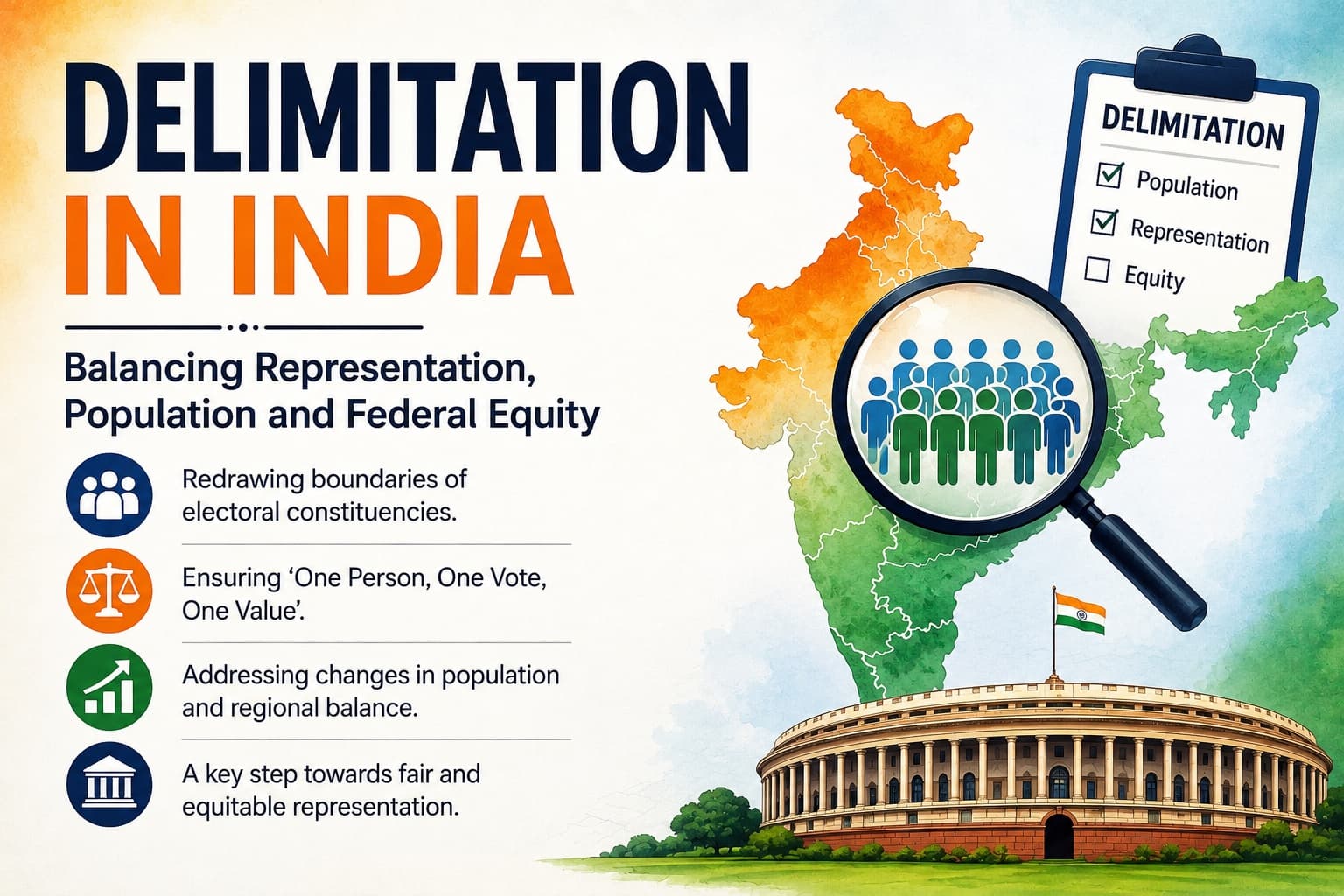
Delimitation is the process of redrawing the boundaries of electoral constituencies and, where constitutionally permitted, readjusting the distribution of seats in the Lok Sabha and State Legislative Assemblies.
The objective is to ensure that electoral constituencies broadly reflect changes in population and uphold the democratic principle of “one person, one vote, one value.”
In India, however, delimitation is not merely an electoral exercise. It has major implications for federalism, political representation, population policy, regional balance and women's reservation.
The issue has gained renewed importance in 2026, as Parliament considered proposals to alter the existing constitutional framework and expand the strength of the Lok Sabha.
1. What Is Delimitation?
Delimitation involves the readjustment of electoral constituencies.
Its major objectives are:
Ensuring broadly equal representation of voters.
Redrawing constituency boundaries according to population changes.
Rationalising electoral constituencies.
Determining reserved constituencies for Scheduled Castes (SCs) and Scheduled Tribes (STs).
Reflecting demographic changes in electoral representation.
The constitutional framework for delimitation primarily involves Articles 82 and 170.
Article 82 deals with readjustment of Lok Sabha constituencies after each Census.
Article 170 deals with the composition and territorial constituencies of State Legislative Assemblies.
After Independence, India's population grew at very different rates across States.
If Lok Sabha seats had been continuously redistributed strictly according to population, States with higher population growth could have gained a significantly larger share of parliamentary representation.
This created a political dilemma.
States that successfully implemented:
Family-planning programmes
Population-control measures
Lower fertility policies
Better demographic management
could potentially have been politically penalised for controlling population growth.
To address this concern, Parliament introduced constitutional safeguards that froze the allocation of Lok Sabha seats among States for a specified period.
The objective was to encourage population stabilisation without reducing a State's political representation.
3. 1971 Census and the 42nd Constitutional Amendment
The 1971 Census became an important reference point in India's delimitation history.
The 42nd Constitutional Amendment Act, 1976 froze the allocation of Lok Sabha seats among States and the division of each State into constituencies until after the first Census following 2000.
The broader objective was to ensure that States implementing successful population-control programmes would not immediately lose parliamentary representation.
Important Distinction
The freeze did not mean that constituency boundaries could never be changed.
There is an important distinction between:
Allocation of seats among States, and
Readjustment of constituencies within a State.
This distinction is important for understanding India's present delimitation framework.
4. The 84th Constitutional Amendment, 2001
The 84th Constitutional Amendment Act, 2001 extended the freeze on the allocation of Lok Sabha seats among States until the first Census after 2026.
At the same time, it permitted readjustment and rationalisation of territorial constituencies within States based on population figures from the 1991 Census.
The amendment therefore created a two-track system:
Inter-State allocation of seats remained frozen.
Constituency boundaries within States could be readjusted.
5. The 87th Constitutional Amendment, 2003
The 87th Constitutional Amendment Act, 2003 subsequently replaced the 1991 Census reference with the 2001 Census for the purpose of constituency readjustment.
Therefore, the present constituency boundaries are substantially linked to the 2001 Census, even though the allocation of Lok Sabha seats among States remained protected by the constitutional freeze.
UPSC Memory Trick
42nd Amendment → Freeze
84th Amendment → Freeze extended till after 2026
87th Amendment → 2001 Census for constituency readjustment
6. The Present 543-Seat Lok Sabha
The Lok Sabha currently has 543 elected constituencies.
The present constituency boundaries are based on the delimitation exercise conducted under the Delimitation Act, 2002, using the 2001 Census.
The constitutional freeze on inter-State allocation of seats explains why India's Lok Sabha representation has not been continuously redistributed according to subsequent population changes.
This has become increasingly significant because India's population distribution has changed substantially since the 1970s.
7. What Does the Delimitation Commission Do?
The Delimitation Commission is constituted under a law enacted by Parliament.
Its functions include:
Determining territorial constituencies.
Redrawing constituency boundaries.
Rationalising constituencies.
Determining reserved constituencies for SCs and STs.
Attempting to maintain reasonable equality in population among constituencies.
The Commission is designed to operate independently of routine political control.
Its orders also enjoy special legal protection under the constitutional and statutory framework governing delimitation.
8. Why Is Delimitation a Federal Issue?
Delimitation can change the relative political strength of different States.
Consider two hypothetical States:
State A
Population: 10 crore
High population growth
State B
Population: 5 crore
Low population growth
If parliamentary seats are allocated strictly according to present population, State A would receive substantially more seats.
But State B may argue that it should not lose political influence because it successfully implemented population-control measures.
This creates the central dilemma:
Should parliamentary representation strictly follow current population, or should the system protect the political representation of States that successfully stabilised their population?
9. Southern States and the Delimitation Debate
The issue is particularly sensitive for several southern States because they generally experienced lower fertility and slower population growth compared with some northern States.
States such as:
Tamil Nadu
Kerala
Karnataka
Andhra Pradesh
Telangana
have therefore raised concerns about the possible consequences of population-based redistribution.
The issue is not simply whether a State gains or loses seats in absolute terms.
The more important question is its share of total Lok Sabha representation.
Example
Suppose a State increases its Lok Sabha seats from:
40 → 50
It has gained 10 seats.
However, if the total Lok Sabha expands substantially and other States gain many more seats, that State's percentage share of the House may still decline.
Therefore, the delimitation debate concerns both:
Absolute representation
Relative representation
10. The 2026 Delimitation Proposal
In April 2026, the Union Government introduced proposals seeking to modify the existing delimitation framework.
The package included:
The Constitution (131st Amendment) Bill, 2026
The Delimitation Bill, 2026
The Union Territories Laws (Amendment) Bill, 2026
The proposals sought to facilitate a new electoral representation framework and increase the potential strength of the Lok Sabha.
11. Proposed Expansion of Lok Sabha
One of the most significant features of the 2026 constitutional amendment proposal was the proposed increase in the maximum strength of the Lok Sabha to 850 members.
The proposed ceiling included:
815 members from States
35 members from Union Territories
The figure of 850 should be understood as the proposed constitutional maximum rather than automatically meaning that the Lok Sabha would immediately consist of exactly 850 elected MPs.
The proposal was intended to provide greater representation while accommodating future population-based changes.
12. Why Was the 2026 Proposal Important?
The proposal was connected to several major constitutional and political objectives.
1. Addressing Representation Gaps
India's population has changed significantly since the existing constituency framework was established.
An expanded Lok Sabha could reduce the number of citizens represented by each MP.
2. Increasing Parliamentary Representation
A larger House could allow more geographically focused constituencies.
3. Facilitating Women's Reservation
The proposal was closely linked with the implementation of the 106th Constitutional Amendment Act, 2023, which introduced reservation of approximately one-third of seats for women.
4. Preparing for Post-2026 Delimitation
The existing constitutional framework had already identified the period after 2026 as a major milestone for future delimitation.
13. Women's Reservation and Delimitation
The 106th Constitutional Amendment Act, 2023 introduced a constitutional framework for reserving approximately one-third of seats for women in:
Lok Sabha
State Legislative Assemblies
Delhi Legislative Assembly
However, the implementation of this reservation was linked to a future delimitation exercise following the relevant Census.
This creates an important constitutional relationship:
Census → Delimitation → Women's Reservation
Any change in the delimitation framework can therefore affect the timeline and method through which women's reservation becomes operational.
14. What Happened on 17 April 2026?
The Constitution (131st Amendment) Bill, 2026 was put to a vote in the Lok Sabha.
Because it was a Constitutional Amendment Bill, it required the special majority prescribed under Article 368.
The Bill failed to secure the required majority.
The reported voting outcome was:
278 votes in favour
211 votes against
Following the defeat of the constitutional amendment proposal, the associated:
Delimitation Bill, 2026
Union Territories Laws (Amendment) Bill, 2026
were subsequently withdrawn.
Therefore, the proposed 2026 framework did not become the new constitutional basis for delimitation.
15. What Does the Defeat Mean?
The defeat does not mean that delimitation has disappeared from India's constitutional agenda.
Instead, it means that the particular legislative route proposed in April 2026 did not succeed.
The broader delimitation question remains relevant because of:
The Census after 2026.
Changing population distribution.
Federal concerns.
Women's reservation.
Representation of different States.
The need to update constituency boundaries.
16. Census 2027 and Future Delimitation
The Census 2027 is therefore highly significant for India's future electoral representation.
The broad relationship can be understood as:
Census
↓
Population Data
↓
Constitutional and Statutory Framework
↓
Delimitation Commission
↓
Constituency Readjustment
↓
Future Elections
However, the publication of Census data does not automatically redraw constituencies.
A legal and constitutional framework is required before the delimitation exercise can be implemented.
17. Census vs Delimitation
These two concepts should not be confused.
Census
The Census is primarily a demographic data-collection exercise.
It provides information about:
Population
Age
Sex
Geographic distribution
Other demographic characteristics
Delimitation
Delimitation is an electoral boundary and representation exercise.
It uses demographic information to determine:
Number and distribution of seats
Constituency boundaries
Reserved constituencies
In One Line
Census provides the demographic data; delimitation translates demographic realities into an electoral representation framework.
18. Major Constitutional Provisions
Provision
Subject
Article 81
Composition of Lok Sabha
Article 82
Readjustment of Lok Sabha constituencies
Article 170
Composition of State Legislative Assemblies
Article 327
Parliament's power regarding elections
Article 368
Constitutional amendment procedure
42nd Amendment, 1976
Introduced the major freeze framework
84th Amendment, 2001
Extended freeze until first Census after 2026
87th Amendment, 2003
Enabled constituency readjustment using 2001 Census
106th Amendment, 2023
Women's reservation framework
19. Advantages of Delimitation
Better Representation
Growing populations can receive more proportionate political representation.
Equality of Votes
Redrawing constituencies can reduce disparities in the number of voters represented by individual MPs.
Administrative Rationalisation
Constituency boundaries can be updated to reflect demographic and administrative changes.
SC/ST Representation
The exercise allows reserved constituencies to be adjusted according to population distribution.
Women's Representation
Delimitation is constitutionally connected with the operationalisation of women's reservation.
20. Major Concerns
1. Federal Balance
States with different population-growth rates could experience major changes in political influence.
2. Population-Control Penalty
States that successfully reduced fertility may argue that population-based redistribution unfairly reduces their relative representation.
3. Political Power
A major redistribution of seats could change the balance of political power among States.
4. Electoral Administration
Redrawing hundreds of constituencies would be a massive administrative undertaking.
5. Constitutional Consensus
Because delimitation affects the federal structure, broad political and inter-State consensus is important.
21. The Core Federalism Question
The delimitation debate ultimately raises a larger constitutional question:
How should India balance democratic equality with federal equity?
There are two competing principles.
Principle 1: Equal Representation
Every citizen should have broadly equal political representation.
This supports allocating seats according to population.
Principle 2: Federal Fairness
States that adopted successful population-control policies should not be disproportionately weakened politically.
This supports safeguards against abrupt redistribution.
The challenge is to design a system that respects both principles.
22. Possible Way Forward
1. Build Inter-State Consensus
The Union Government and States should engage in structured consultations before any future delimitation exercise.
2. Protect Federal Balance
The formula should avoid disproportionately disadvantaging States because of successful demographic transition.
3. Expand Representation Carefully
A larger Lok Sabha can provide greater representation while limiting abrupt changes in the relative political weight of States.
4. Ensure Transparency
The population data, methodology and seat-allocation formula should be publicly available.
5. Coordinate With Women's Reservation
Women's reservation and delimitation should be implemented through a coherent constitutional and administrative framework.
6. Preserve Democratic Equality
At the same time, long-term distortions in the population-to-representative ratio cannot be ignored.
23. UPSC Prelims Quick Revision
India currently has 543 elected Lok Sabha constituencies.
The current constituency boundaries are substantially based on the 2001 Census.
The freeze on inter-State allocation of Lok Sabha seats continues until the first Census after 2026.
The 42nd Constitutional Amendment introduced the major freeze framework.
The 84th Constitutional Amendment extended the freeze until after 2026.
The 87th Constitutional Amendment enabled constituency readjustment using the 2001 Census.
The 106th Constitutional Amendment introduced the women's reservation framework.
The 2026 proposal sought to increase the maximum strength of the Lok Sabha to 850.
The proposed composition included 815 members from States and 35 from Union Territories.
The Constitution Amendment Bill was defeated in the Lok Sabha on 17 April 2026.
The reported vote was 278–211.
The associated Delimitation Bill and UT Laws Amendment Bill were subsequently withdrawn.
24. UPSC Mains Perspective
Possible Question
“Delimitation is not merely an electoral exercise but a test of India's federal balance.” Discuss.
Suggested Structure
Introduction
Define delimitation and mention Articles 82 and 170.
Body
Discuss:
Historical freeze.
Population-control rationale.
Need for equitable representation.
Southern States' concerns.
Women's reservation.
2026 legislative developments.
Federal implications.
Need for consensus.
Conclusion
India needs a delimitation framework that balances democratic equality, federal equity and constitutional legitimacy.
Conclusion
Delimitation is one of the most consequential constitutional questions facing India's electoral system.
At its core, it concerns who gets represented, how much representation citizens receive, and how India's federal balance should evolve with demographic change.
The historical freeze attempted to protect States that pursued population stabilisation. Decades later, however, India's population distribution has changed substantially, creating pressure to reconsider the existing framework.
The 2026 legislative developments demonstrate that delimitation cannot be treated as merely a technical exercise of redrawing constituency boundaries. It involves federalism, democratic equality, population policy, women's representation, constitutional amendment and the distribution of political power among States.
For UPSC aspirants, the issue should therefore be studied through the combined lens of:
Delimitation seeks to align electoral representation with demographic realities, but in India it must simultaneously balance “one person, one vote” with federal equity and the interests of States that pursued population stabilisation.